
Effective Resistivity in Relativistic Reconnection: A Prescription Based on Fully Kinetic Simulations
Abigail Moran, Lorenzo Sironi, Aviad Levis, Bart Ripperda, Elias R. Most, Sebastiaan Selvi
The Astrophysical Journal Letters · 2025
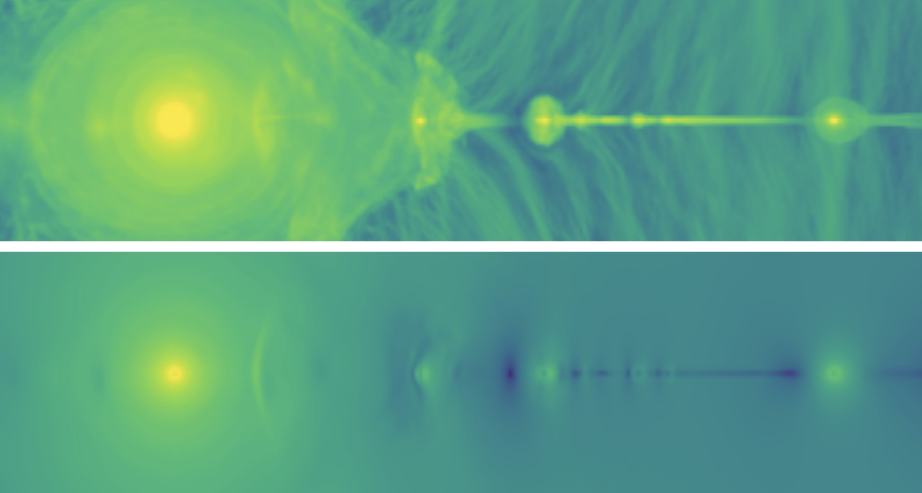
A variety of high-energy astrophysical phenomena are powered by the release -- via magnetic reconnection -- of the energy stored in oppositely directed fields. Single-fluid resistive magnetohydrodynamic (MHD) simulations with uniform resistivity yield dissipation rates that are much lower (by nearly one order of magnitude) than equivalent kinetic calculations. Reconnection-driven phenomena could be accordingly modeled in resistive MHD employing a non-uniform, ``effective'' resistivity informed by kinetic calculations. In this work, we analyze a suite of fully kinetic particle-in-cell (PIC) simulations of relativistic pair-plasma reconnection -- where the magnetic energy is greater than the rest mass energy -- for different strengths of the guide field orthogonal to the alternating component. We extract an empirical prescription for the effective resistivity, ηeff=αB0|J|p/(|J|p+1+(entc)p+1), where B0 is the reconnecting magnetic field strength, J is the current density, nt the lab-frame total number density, e the elementary charge, and c the speed of light. The guide field dependence is encoded in α and p, which we fit to PIC data. This resistivity formulation -- which relies only on single-fluid MHD quantities -- successfully reproduces the spatial structure and strength of nonideal electric fields, and thus provides a promising strategy for enhancing the reconnection rate in resistive MHD simulations.